K-LIBRE: The Neural Supply Chain — AI-Driven Optimization for Food & Perishables
Industry Whitepaper | 2026 — RNV Analytics & K-LIBRE Research Team
Executive Summary
The food and perishables industry operates in one of the most volatile and operationally complex supply chain environments in the world. Short product life cycles, fluctuating consumer demand, seasonal variability, supply uncertainty, and high waste rates make traditional planning systems insufficient for modern retail and manufacturing operations. K-LIBRE introduces a new generation of AI-powered supply chain intelligence specifically designed for food and perishables ecosystems — combining neural forecasting, autonomous allocation optimization, dynamic replenishment, and real-time decision intelligence to create a continuously learning supply chain.
1. The Food & Perishables Supply Chain Challenge
Food and perishables supply chains are fundamentally different from conventional retail supply chains. They are driven by highly dynamic variables that create significant operational pressure across procurement, production, distribution, and store operations.
1.1 Short Shelf Life
Products such as bakery goods, dairy products, fresh produce, meat, and ready-to-eat meals have extremely limited selling windows. Overstocking leads directly to waste and margin loss, while understocking results in lost sales and customer dissatisfaction.
1.2 Demand Volatility
Demand patterns in food retail are influenced by a wide range of real-time variables:
- Weather conditions and seasonal changes
- Promotions and local events
- Holidays and daypart consumption patterns
- Consumer behavior shifts and regional preferences
1.3 Waste Management Pressure
Food waste is both a financial and sustainability issue. Retailers and manufacturers face increasing pressure to reduce waste while maintaining high service levels.
1.4 Complex Multi-Echelon Operations
Food supply chains involve interconnected networks including:
- Suppliers and manufacturing facilities
- Distribution centers and cold chain logistics
- Retail stores, dark stores, and fulfillment centers
1.5 Operational Speed Requirements
Perishable supply chains require rapid decision-making cycles. Delays in replenishment, allocation, or production planning can create immediate operational consequences.
2. Why Traditional Supply Chain Systems Fail
Most legacy supply chain planning systems were built around static assumptions and deterministic logic. These systems were not designed for modern food retail complexity.
3. Introducing the Neural Supply Chain
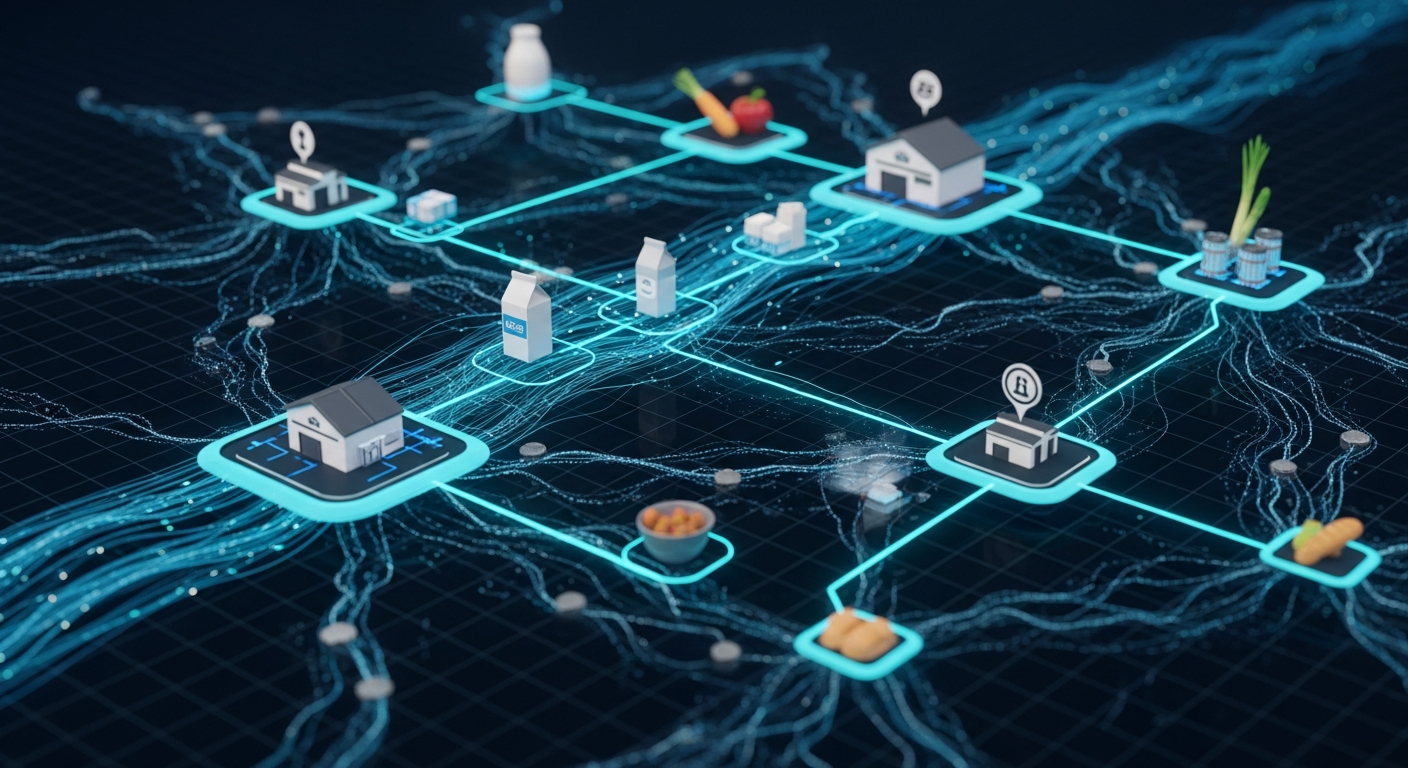
Instead of relying on static rules and periodic planning cycles, neural supply chains continuously learn from real-time data and autonomously optimize operational decisions. K-LIBRE enables this transformation through advanced AI and machine learning technologies.
A neural supply chain:
- Continuously learns from operational data and detects changing patterns in real time
- Optimizes decisions autonomously and simulates multiple scenarios instantly
- Adjusts inventory dynamically and predicts operational risks before they occur
- Synchronizes decisions across the entire network
4. K-LIBRE Platform Architecture
Module 4.1AI Demand Forecasting Engine
The forecasting engine processes historical sales, real-time POS data, weather signals, promotions, seasonal patterns, local events, product lifecycle changes, and external market variables. Machine learning models continuously retrain themselves based on emerging patterns.
- SKU-store level and intra-day demand forecasting
- Cannibalization analysis and promotion uplift forecasting
- New product and regional demand modeling
Module 4.2Autonomous Allocation Optimization
K-LIBRE dynamically allocates inventory based on demand probability, shelf-life constraints, store performance, logistics conditions, real-time availability, and margin optimization. The system continuously rebalances inventory across the network.
Module 4.3Smart Replenishment
The replenishment engine generates adaptive recommendations using real-time demand changes, sell-through rates, waste thresholds, store capacity, and supply variability — minimizing both stockouts and overstock.
Module 4.4Production Optimization
For manufacturers and fresh food operations, K-LIBRE supports production scheduling, batch optimization, raw material synchronization, yield management, and capacity balancing — enabling production aligned with actual demand signals.
Module 4.5Control Tower & Decision Intelligence
A centralized operational intelligence layer delivering real-time visibility, exception alerts, predictive risk monitoring, AI recommendations, scenario simulations, and KPI monitoring — giving decision-makers a unified view of the entire supply chain.
5. AI Models & Learning Framework
Deep Learning Forecasting
Neural networks identify complex non-linear demand relationships that traditional statistical methods cannot detect.
Reinforcement Learning
The system continuously improves decision quality by learning from operational outcomes.
Probabilistic Forecasting
K-LIBRE produces demand probability ranges to support risk-aware decision-making.
Edge Intelligence
Store-level and regional intelligence enables localized optimization decisions.
6. Business Impact & ROI
7. Use Cases
Fresh Bakery Operations
K-LIBRE predicts hourly demand patterns and optimizes production quantities for each location.
- Reduced end-of-day waste
- Higher freshness availability
- Improved labor planning
Grocery Retail Chains
Retailers use K-LIBRE to optimize inventory distribution across stores.
- Improved shelf availability
- Lower inventory holding costs
- Better promotion execution
Dairy & Cold Chain Distribution
The platform optimizes replenishment timing and inventory movement across temperature-sensitive networks.
- Reduced spoilage
- Improved cold chain efficiency
- Faster response to demand shifts
Quick Commerce & Dark Stores
High-frequency fulfillment environments require ultra-fast inventory decisions.
- Hyperlocal forecasting
- Dynamic replenishment
- Real-time allocation
8. Implementation Approach
Phase 1 — Data Integration
The platform integrates with ERP, POS, WMS, supply chain applications, and external data sources.
Phase 2 — AI Model Training
Historical operational data is used to train forecasting and optimization models.
Phase 3 — Pilot Deployment
A pilot environment validates performance and operational impact.
Phase 4 — Enterprise Rollout
The platform expands across locations, categories, and supply chain functions.
9. Why K-LIBRE & RNV Analytics
Industry-Specific Intelligence
Designed specifically for food and perishables operations.
AI-Native Architecture
Built from the ground up using modern machine learning frameworks.
Rapid Time-to-Value
Measurable operational improvements within weeks.
Continuous Learning
Models improve automatically as more operational data becomes available.
The Future of Autonomous Supply Chains
The next generation of supply chains will increasingly rely on autonomous decision intelligence. AI-driven neural supply chains will enable self-optimizing inventory, autonomous replenishment, predictive logistics, intelligent production planning, and real-time network orchestration. K-LIBRE represents a major step toward this future.
Conclusion
The food and perishables industry can no longer rely on traditional supply chain planning methods to compete in a high-volatility environment. Organizations need systems capable of learning, adapting, and optimizing continuously. K-LIBRE delivers a neural supply chain platform that combines AI forecasting, dynamic optimization, and autonomous decision intelligence to help organizations reduce waste, improve availability, increase profitability, accelerate operational responsiveness, and build more sustainable operations.